

Strong Japanese last names carry power, honor, and history. Many of them come from warriors, mountains, rivers, and old clans. Each name tells a small story.
People look for these names for many reasons. Some want a name for a baby. Others need one for a book, a game, or a screenplay. A strong surname adds weight to any character.
In this guide, you will find 600+ strong Japanese last names and their meanings. Every section has a clear theme. You can browse, pick your favorite, and use it with confidence.
Strong Japanese Last Names Generator
Random Name Generator
Click the button to discover a new name instantly.
Strong Japanese Last Names
- Takeda – warrior field
- Tokugawa – virtuous river
- Oda – weaving field
- Toyotomi – abundant retainer
- Uesugi – upper cedar
- Mori – forest
- Shimazu – island harbor
- Date – bold and stylish clan name
- Hattori – clothing weaver, linked to ninja clans
- Sanada – famous warrior clan name
- Kuroda – black field
- Ishida – stone field
- Maeda – front field
- Hosokawa – narrow river
- Asano – shallow field
- Akechi – bright wisdom
- Imagawa – present river
- Chosokabe – famous clan of Tosa
- Hojo – northern branch
- Ikeda – pond field
- Kato – add wisteria
- Fukushima – fortune island
- Honda – main field
- Sakai – sake well
- Ii – well and noble clan
- Matsudaira – pine plain
- Nabeshima – pot island
- Tachibana – orange tree
- Kuki – nine demons
- Ogasawara – small bamboo-hat plain
- Ashikaga – foot and profit
- Minamoto – source
- Taira – peace, level ground
- Fujiwara – wisteria plain
- Sugawara – sedge plain
- Abe – corner of a hill
- Wada – harmony field
- Yamana – mountain name
- Otomo – great friend
- Satake – helper bamboo
What Are Strong Japanese Last Names?
- Iwasaki – rocky cape
- Iwata – rock field
- Iwamoto – base of the rock
- Iwakura – rock storehouse
- Iwase – rock rapids
- Iwanaga – long rock
- Iwabuchi – rock pool
- Iwahashi – rock bridge
- Iwama – rock space
- Iwaki – rock castle
- Kumagai – bear valley
- Kumazawa – bear marsh
- Kumamoto – base of the bear
- Kumada – bear field
- Kumano – bear field plain
- Kumakura – bear storehouse
- Kumagae – bear and stream
- Kumabe – bear region
- Toraya – tiger house
- Toramaru – tiger circle
- Torikai – bird keeper
- Takagi – tall tree
- Takahashi – tall bridge
- Takano – tall field
- Takamura – tall village
- Takayama – tall mountain
- Takashima – tall island
- Takamatsu – tall pine
- Takaoka – tall hill
- Takeuchi – inside the bamboo
- Takenaka – middle of the bamboo
- Takemoto – base of the bamboo
- Takehara – bamboo plain
- Takei – bamboo well
- Takekura – bamboo storehouse
- Takezawa – bamboo marsh
- Takesue – end of the bamboo
- Takegami – bamboo above
- Takeshita – below the bamboo
- Takeyasu – bamboo peace
Why Some Japanese Last Names Symbolize Strength
- Kanazawa – golden marsh
- Kanemoto – base of the metal
- Kaneko – metal child
- Kanai – metal well
- Kanamori – metal forest
- Kanehara – metal plain
- Kanesaka – metal slope
- Kaneshiro – metal castle
- Kanetsuka – metal mound
- Kanzaki – god’s cape
- Hagiwara – bush clover plain
- Hagane – steel
- Haganuma – steel swamp
- Tsurugi – sword
- Tsurugida – sword field
- Tsurumi – sword view
- Tsuruta – crane field
- Kenmochi – sword holder
- Kenjo – sword castle
- Kenda – sword field
- Katsuragi – victory castle
- Katsuyama – victory mountain
- Katsumata – victory fork
- Katsura – laurel tree
- Katsuki – victory tree
- Masuda – increase field
- Masuyama – increase mountain
- Masaki – true tree
- Masamune – true ridge
- Masumoto – base of increase
- Gouda – strong field
- Gohara – strong plain
- Gomi – strong beauty
- Goto – behind the strong
- Goryo – strong ruler
- Yuasa – brave shallows
- Yuuki – brave tree
- Isobe – rocky shore region
- Isomura – rocky village
- Isogai – rocky shore
Strong Japanese Last Names Inspired by Warriors
- Miyamoto – base of the shrine
- Yagyu – fertile willow, famed sword school
- Kamiizumi – upper spring
- Tsukahara – mound plain
- Chiba – thousand leaves
- Hijikata – earth direction
- Okita – open rice field
- Nagakura – long storehouse
- Harada – plain field
- Todo – wisteria hall
- Yamanami – mountain wave
- Kojima – small island
- Itto – one sword
- Shinmen – new face
- Aizu – meeting harbor
- Sakamoto – base of the slope
- Katsura – laurel
- Takasugi – tall cedar
- Kido – wooden door
- Saigo – west village
- Okubo – big hollow
- Itagaki – board fence
- Etō – wisteria inlet
- Soejima – accompanying island
- Yamagata – mountain shape
- Nogi – field tree
- Oyama – big mountain
- Kuribayashi – chestnut forest
- Yamashita – below the mountain
- Yamamoto – base of the mountain
- Togo – east village
- Yoshii – good well
- Hirose – wide rapids
- Akiyama – autumn mountain
- Kodama – spirit echo
- Terauchi – inside the temple
- Katsu – victory
- Enomoto – base of the hackberry
- Nakaoka – middle hill
- Takechi – warrior place
Samurai Family Last Names
- Shibata – brushwood field
- Niwa – garden
- Takigawa – waterfall river
- Hachisuka – bee nest
- Ukita – floating field
- Mogami – upper river
- Nanbu – southern part
- Tsugaru – name of a northern region
- Ando – peaceful wisteria
- Sakakibara – sacred tree plain
- Okubo – great hollow
- Hotta – dug field
- Matsumae – pine front
- Tsutsui – cylinder well
- Hatakeyama – field mountain
- Isshiki – one color
- Kyogoku – capital’s end
- Rokkaku – six corners
- Akamatsu – red pine
- Yamauchi – inside the mountain
- Tozawa – door marsh
- Naoe – straight inlet
- Amako – sweet child clan
- Kikkawa – turtle river
- Kobayakawa – small fast river
- Ouchi – great inside
- Soma – grass horse
- Sagara – mutual good
- Ryuzoji – dragon tree temple
- Arima – has horse
- Omura – big village
- Hirado – flat door
- Gamo – cattail field
- Tsuchiya – earth house
- Anayama – hole mountain
- Obata – small field
- Baba – horse ground
- Naito – inner wisteria
- Kasuya – lees valley
- Aoyama – blue mountain
Powerful Japanese Last Names Inspired by Nature
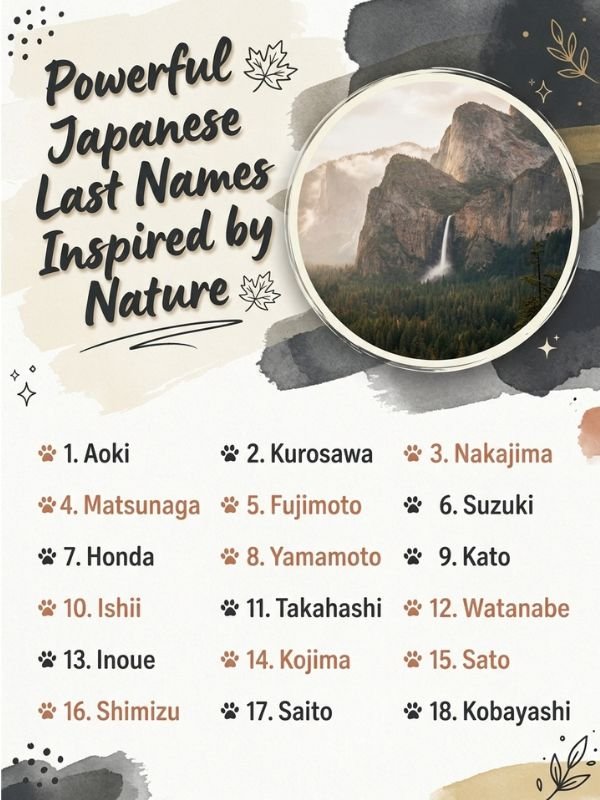
- Kawakami – above the river
- Kawasaki – river cape
- Kawaguchi – river mouth
- Kawamura – river village
- Ishikawa – stone river
- Mizuno – water field
- Mizuhara – water plain
- Morishita – below the forest
- Morimoto – base of the forest
- Morioka – forest hill
- Sugimoto – base of the cedar
- Sugiyama – cedar mountain
- Sugita – cedar field
- Matsuda – pine field
- Matsuo – pine tail
- Matsuura – pine bay
- Kazama – wind space
- Oshima – big island
- Umino – sea field
- Hoshino – star field
- Tsukino – moon field
- Tanigawa – valley river
- Tanimoto – base of the valley
- Fujimoto – base of the wisteria
- Fujisawa – wisteria marsh
- Nagano – long field
- Nagata – long rice field
- Hirano – flat field
- Ogata – small shape, little grove
- Noda – field of fields
- Nonaka – middle of the field
- Nomura – field village
- Arakawa – rough river
- Shiraishi – white stone
- Shirakawa – white river
- Mizushima – water island
- Kitagawa – north river
- Minamikawa – south river
- Higashikawa – east river
- Nishikawa – west river
Strong Japanese Last Names With Historical Origins
- Soga – a powerful ancient clan
- Mononobe – ancient military clan
- Nakatomi – middle minister
- Kamo – shrine family of Kyoto
- Haji – potters of old Japan
- Imbe – ritual priests
- Hata – a clan of skilled settlers
- Koma – Goguryeo origin
- Ato – a minor ancient clan
- Izumo – rising clouds, ancient province
- Kusakabe – grass region
- Oe – big river
- Kiyohara – clean plain
- Ono – small field
- Ariwara – exists plain
- Kose – old court family
- Kibi – ancient province name
- Sakanoue – above the slope
- Tajihi – ancient royal line
- Nagaya – long house
- Yamabe – mountain region
- Fuwa – not shaken
- Miyoshi – three good
- Urabe – diviner
- Nakahara – middle plain
- Kasuga – spring day
- Nara – ancient capital
- Heguri – old noble clan
- Katsuragi – ancient clan
- Wani – crocodile, old court scholars
- Kishi – old clan name
- Ki – tree, ancient clan
- Mikami – three above
- Mibu – lowly field
- Yasuda – peaceful field
- Tamura – rice field village
- Kuwabara – mulberry plain
- Oyamada – big mountain field
- Sagami – old province name
- Echizen – old province name
Strong Japanese Last Names With Powerful Meanings
- Ryuzaki – dragon cape
- Tatsumi – southeast, dragon and snake
- Tatsuno – dragon field
- Ryuguji – dragon palace
- Kirishima – fog island
- Shishido – lion door
- Shishikura – lion storehouse
- Shishimura – lion village
- Ohtori – great bird
- Hououin – phoenix temple
- Tsukishiro – moon castle
- Amakusa – heavenly grass
- Kaminari – thunder
- Raiden – thunder field
- Arashiyama – storm mountain
- Kazehaya – swift wind
- Hayabusa – falcon
- Hayashida – forest rice field
- Hayami – fast beauty
- Sagiri – mist cutting
- Homura – flame
- Honoo – blaze
- Kagari – bonfire
- Enjoji – flame temple
- Enomoto – hackberry base
- Hiyama – sun mountain
- Hinata – sunny place
- Hikari – light
- Hikawa – sun river
- Asahina – morning sun
- Asahi – morning sun
- Akatsuki – dawn
- Yoake – daybreak
- Kogarashi – winter wind
- Fubuki – snowstorm
- Yukihara – snow plain
- Yukimura – snow village
- Mikazuki – crescent moon
- Seiryu – blue dragon
- Byakko – white tiger
More Strong Japanese Last Names to Consider
- Daimon – great gate
- Daigo – great enlightenment
- Daito – great east
- Obara – small plain
- Obayashi – big forest
- Ogura – small storehouse
- Oka – hill
- Okabe – hill region
- Okumura – deep village
- Okuyama – deep mountain
- Ohara – big plain
- Ohashi – big bridge
- Ohno – big field
- Ohtsuka – big mound
- Sawada – marsh field
- Sawamura – marsh village
- Sawai – marsh well
- Segawa – rapids river
- Seki – barrier
- Sekiguchi – barrier mouth
- Sekine – barrier root
- Shigeta – luxuriant field
- Shibuya – bitter valley
- Shindo – new path
- Shinohara – bamboo grass plain
- Shiozaki – salt cape
- Soeda – accompanying field
- Sone – foundation
- Tabata – rice field
- Tagawa – rice field river
- Taguchi – rice field mouth
- Tajima – rice field island
- Teshima – hand island
- Toyoda – abundant field
- Tsuda – harbor field
- Tsukamoto – base of the mound
- Uchida – inside the field
- Ueno – upper field
- Wakabayashi – young forest
- Yokoyama – side mountain
Modern Strong Japanese Last Names
- Kaneko – metal child
- Nomura – field village
- Maruyama – round mountain
- Noguchi – field mouth
- Kikuchi – chrysanthemum pond
- Nakajima – middle island
- Tamura – rice field village
- Konishi – little west
- Kubo – hollow
- Matsui – pine well
- Sugiura – cedar bay
- Ichikawa – one river
- Imai – now well
- Kanda – god’s field
- Uehara – upper plain
- Taniguchi – valley mouth
- Nakayama – middle mountain
- Koyama – small mountain
- Yoshikawa – lucky river
- Yamashiro – mountain castle
- Hirata – flat field
- Sakurai – cherry blossom well
- Sakuraba – cherry blossom place
- Sakuma – cherry blossom space
- Shinoda – bamboo field
- Fujiwara – wisteria field
- Aihara – love plain
- Akimoto – base of autumn
- Amano – heavenly field
- Ando – peaceful wisteria
- Arai – new well
- Baba – horse ground
- Doi – earth well
- Fujimura – wisteria village
- Fukai – deep well
- Furuta – old field
- Hamada – beach field
- Hamasaki – beach cape
- Higuchi – fire mouth
- Hirayama – flat mountain
Strong Japanese Last Names Inspired by Courage
- Yuki – bravery, courage
- Yuuma – brave truth
- Isami – courageous
- Isamu – brave
- Yusa – brave helper
- Yumoto – hot spring base
- Yamato – great harmony
- Yamaji – mountain road
- Tsuyama – strong mountain
- Tsuyuki – strong snow
- Tsuyoshi – strong
- Takeshi – fierce warrior
- Takemura – warrior village
- Takezono – warrior garden
- Mitsui – three wells
- Mitsuya – three valleys
- Mitsuhashi – three bridges
- Makino – shepherd’s field
- Makita – pasture field
- Makabe – true region
- Seino – sacred field
- Seiko – sincere child
- Seiya – clear night
- Seta – rapids field
- Shoji – proper ruler
- Shoda – proper field
- Sho – soar
- Sohma – grass horse
- Sorimachi – bent town
- Soma – grass horse clan
- Sone – foundation
- Sonoda – garden field
- Susukida – pampas field
- Suwa – lake shrine
- Tomita – wealthy field
- Tomoyoshi – good friend
- Toyama – abundant mountain
- Tsubaki – camellia
- Tsubasa – wings
- Tsubota – jar field
Strong Japanese Last Names With Meaning
| Last Name | Kanji | Meaning | Feeling It Gives |
| Takeda | 武田 | Warrior field | Honor and leadership |
| Tokugawa | 徳川 | Virtue river | Authority and rule |
| Oda | 織田 | Weaving field | Ambition and vision |
| Hattori | 服部 | Cloth weaver | Stealth and skill |
| Miyamoto | 宮本 | Base of the shrine | Discipline and mastery |
| Date | 伊達 | Bold and stylish | Confidence |
| Ishikawa | 石川 | Stone river | Steady strength |
| Yamamoto | 山本 | Base of the mountain | Calm power |
| Fujiwara | 藤原 | Wisteria plain | Noble class |
| Kuroda | 黒田 | Black field | Mystery and force |
| Uesugi | 上杉 | Upper cedar | Tall and proud |
| Kurosawa | 黒沢 | Black marsh | Dark and deep |
| Matsudaira | 松平 | Pine plain | Endurance |
| Tachibana | 橘 | Orange tree | Pride and loyalty |
| Minamoto | 源 | Source | Origin and legacy |
Strong Japanese Last Names for Fictional Characters
- Kirigaya – fog valley
- Hyuga – facing the sun
- Kisaragi – second month of the lunar year
- Shinomiya – bamboo shrine
- Tsukishima – moon island
- Kujo – nine articles
- Kamishiro – upper castle
- Sumeragi – imperial rule
- Shirogane – silver
- Hiiragi – holly
- Amamiya – rain shrine
- Akagi – red castle
- Aizen – indigo dye
- Kamijo – upper article
- Kagurazaka – sacred music slope
- Kiryu – paulownia willow
- Kurenai – crimson
- Kurogane – black iron
- Mikasa – three umbrellas
- Nanami – seven seas
- Narukami – thundergod
- Orihara – weaving plain
- Reiji – cold ruler
- Saotome – maiden
- Shiranui – unknown fire
- Sohryu – azure dragon
- Suou – deep red
- Tendo – heavenly hall
- Toudou – wisteria hall
- Uzumaki – whirlpool
- Utsunomiya – shrine in the field
- Yagami – night god
- Yukishiro – snow castle
- Zenin – all-seeing temple
- Ayanokoji – silk alley
- Fushiguro – hidden black
- Gojo – five articles
- Hashira – pillar
- Kuchiki – rotten tree
- Mugen – infinity
Famous Strong Japanese Last Names
- Tokugawa – shogun family
- Toyotomi – unifier’s family
- Kurosawa – film director’s name
- Miyazaki – shrine cape
- Murakami – village above
- Ichiro – first son
- Hokusai – north studio
- Basho – banana tree
- Natsume – jujube
- Mishima – three islands
- Akutagawa – sea grass river
- Kawabata – river edge
- Tezuka – hand mound
- Honda – main field
- Toyoda – abundant rice field
- Suzuki – bell tree
- Yamaha – mountain blade
- Matsushita – below the pine
- Kikkoman – tortoise-shell ten thousand
- Nakamoto – base of the middle
- Ishiguro – stone black
- Oe – big inlet
- Ozu – small harbor
- Kitano – north field
- Nagase – long rapids
- Fukuzawa – fortune marsh
- Itagaki – board fence
- Ito – wisteria
- Iwakura – rock storehouse
- Okuma – big bear
- Yamagata – mountain shape
- Kuroki – black tree
- Terajima – temple island
- Umezawa – plum marsh
- Sakata – slope field
- Ogawa – small river
- Hirohito – plentiful benevolence
- Shimura – lowly village
- Otani – big valley
- Kuwata – mulberry field
Tips for Choosing a Strong Japanese Last Name
- Kitamura – north village
- Kitazawa – north marsh
- Kitajima – north island
- Kitaoka – north hill
- Minami – south
- Minamino – south field
- Minamiyama – south mountain
- Higashi – east
- Higashiyama – east mountain
- Higashino – east field
- Nishi – west
- Nishida – west field
- Nishiyama – west mountain
- Nishino – west field
- Nishioka – west hill
- Furukawa – old river
- Furuya – old valley
- Hirose – wide rapids
- Hiroshima – wide island
- Hiroyama – wide mountain
- Kitahara – north plain
- Kojima – small island
- Komatsu – small pine
- Komori – small forest
- Kondo – near wisteria
- Konno – dark blue field
- Koizumi – small spring
- Kudo – craftsman’s wisteria
- Kunimoto – base of the country
- Kuramochi – storehouse keeper
- Kurihara – chestnut plain
- Kurita – chestnut field
- Kusunoki – camphor tree
- Kuze – nine rapids
- Machida – town field
- Maki – pasture
- Matsubara – pine plain
- Matsunaga – long pine
- Matsushima – pine island
- Mikami – three above
Japanese Last Names With Dark Meanings
- Kurosaki – black cape
- Kuroki – black tree
- Kurogi – black wood
- Kuroiwa – black rock
- Kurokawa – black river
- Kurosu – black nest
- Kurobe – black region
- Kuroyanagi – black willow
- Kurohane – black feather
- Kurosawa – black marsh
- Kurosaka – black slope
- Kurotani – black valley
- Kuronuma – black swamp
- Kageyama – shadow mountain
- Kagemoto – base of the shadow
- Kageura – shadow bay
- Kagesawa – shadow marsh
- Kageno – shadow field
- Kagetani – shadow valley
- Kagemura – shadow village
- Onizuka – demon mound
- Onoda – small demon field
- Oniki – demon tree
- Onishi – demon west
- Onimaru – demon circle
- Onibe – demon region
- Oniyama – demon mountain
- Hakamada – hakama field
- Yamiya – darkness house
- Yomiya – underworld house
- Tsukikage – moon shadow
- Yoruichi – night one
- Yozora – night sky
- Shinigami – death god
- Akuma – devil
- Kurayami – darkness
- Mayoi – lost
- Kasumi – mist
- Yamigami – dark god
- Kuraki – dark tree
Japanese Last Names Uncommon
- Kogure – small dusk
- Ogiwara – silver grass plain
- Tsukamoto – mound base
- Kamiya – god valley
- Kamiyama – god mountain
- Kamino – god field
- Kaminaga – long god
- Kawai – river well
- Kawano – river field
- Kiriyama – fog mountain
- Kirino – fog field
- Kirihara – fog plain
- Kitsune – fox
- Kitagami – north god
- Komiya – small shrine
- Konami – small wave
- Kosugi – small cedar
- Kotoba – word leaf
- Kuga – nine fangs
- Kujira – whale
- Kumoi – cloud well
- Kunieda – country branch
- Kusaka – grass slope
- Kuwano – mulberry field
- Maeno – front field
- Mamiya – true house
- Mashiba – true brushwood
- Mase – true rapids
- Matoba – target place
- Mayuzumi – eyebrow ink
- Mikuni – three countries
- Mitani – three valleys
- Mizoguchi – ditch mouth
- Mochizuki – full moon
- Momose – peach rapids
- Monden – gate field
- Muto – dance wisteria
- Nakadai – middle stand
- Naruse – ringing rapids
- Nezu – root west
Japanese Last Names for Girls
- Hanazono – flower garden
- Hanada – flower field
- Hanamura – flower village
- Hanaoka – flower hill
- Sakurada – cherry blossom field
- Himeno – princess field
- Himekawa – princess river
- Yukimura – snow village
- Tsukimoto – moon base
- Hoshizaki – star cape
- Hoshikawa – star river
- Asahina – morning sun
- Ayase – colorful rapids
- Ayakawa – colorful river
- Misaki – beautiful cape
- Mizuki – beautiful moon
- Mizuno – water field
- Minase – water rapids
- Nozomi – hope
- Natsuki – summer tree
- Natsukawa – summer river
- Aizawa – love marsh
- Aikawa – love river
- Amane – heaven’s sound
- Amano – heavenly field
- Chihara – thousand plains
- Chinen – thousand years
- Haruno – spring field
- Harukawa – spring river
- Hasegawa – valley river
- Hiiragi – holly
- Kasumi – mist
- Kikuta – chrysanthemum field
- Kikuno – chrysanthemum field
- Kozue – treetop
- Mikage – beautiful shadow
- Nanase – seven rapids
- Ririka – jasmine flower
- Shiori – bookmark
- Utsumi – inner sea
Japanese Last Names Unique
- Amagi – heaven’s castle
- Amakawa – heaven river
- Amamiya – rain shrine
- Aoi – hollyhock
- Aonuma – blue swamp
- Arisaka – exists slope
- Asakura – morning storehouse
- Asagiri – morning mist
- Fujimaru – wisteria circle
- Fujisaki – wisteria cape
- Fukuhara – fortune plain
- Fukumoto – fortune base
- Fukuoka – fortune hill
- Funakoshi – boat crossing
- Furusawa – old marsh
- Gotoh – behind wisteria
- Haibara – ash plain
- Hamaguchi – beach mouth
- Hanyu – hemp field
- Hirasawa – flat marsh
- Hirokawa – wide river
- Hisakawa – long-lasting river
- Hoshina – star name
- Hozumi – ear of grain
- Ibuki – breath
- Ichinose – first rapids
- Igarashi – fifty storms
- Ikari – anchor
- Inaba – rice leaf
- Inagaki – rice fence
- Inamura – rice village
- Irie – inlet
- Isurugi – rock sword
- Izawa – well marsh
- Izumi – spring
- Jinno – god field
- Kabura – turnip
- Kadokura – gate storehouse
- Kajiwara – blacksmith plain
- Kakehashi – bridge
Japanese Last Names With Beautiful Meanings
- Sakura – cherry blossom
- Sakurai – cherry blossom well
- Kasumigaoka – mist hill
- Tsukino – of the moon
- Umeda – plum field
- Umeno – plum field
- Umemura – plum village
- Momoi – peach well
- Momota – peach field
- Kikuchi – chrysanthemum pond
- Ayanokoji – silk alley
- Aoki – green tree
- Aomori – blue forest
- Aozora – blue sky
- Himawari – sunflower
- Hinode – sunrise
- Hotaru – firefly
- Kaede – maple
- Kaedeno – maple field
- Kawaii – lovely
- Kirameki – sparkle
- Kohaku – amber
- Koharu – small spring
- Komorebi – sunlight through trees
- Kotone – harp sound
- Mizuhara – water plain
- Niji – rainbow
- Nijiya – rainbow house
- Ogiwara – silver grass plain
- Rin – dignified
- Ryoko – cool child
- Sayuri – small lily
- Shimizu – clear water
- Suzuran – lily of the valley
- Tachibana – orange blossom
- Tenma – heaven’s horse
- Tomoe – comma-shaped crest
- Wakaba – young leaf
- Yayoi – spring month
- Yuzuki – gentle moon
Popular Japanese Last Names
- Kaneda – metal field
- Kariya – hunting valley
- Kasai – west well
- Katayama – side mountain
- Kawata – river field
- Kimata – tree fork
- Kinoshita – below the tree
- Kishimoto – base of the shore
- Kishi – shore
- Kitada – north field
- Kitani – north valley
- Kiyama – tree mountain
- Kobe – god’s door
- Kodera – small temple
- Kojo – lake castle
- Kokubo – country hollow
- Komine – small peak
- Konishi – small west
- Koide – small exit
- Kumai – bear well
- Kurosu – black nest
- Mano – true field
- Maruta – round field
- Masaoka – true hill
- Mase – true rapids
- Matsubayashi – pine forest
- Matsuzaki – pine cape
- Mimura – three villages
- Miyahara – shrine plain
- Miyajima – shrine island
- Miyake – shrine house
- Miyazawa – shrine marsh
- Mizutani – water valley
- Morita – forest field
- Moriyama – forest mountain
- Motohashi – base bridge
- Nagai – long well
- Nagao – long tail
- Nakai – middle well
- Nakata – middle field
Traditional Japanese Last Names
- Hirose – wide rapids
- Fukui – fortune well
- Furuhata – old field
- Hashiba – bridge place
- Hatano – cloth field
- Hirabayashi – flat forest
- Hosoda – narrow field
- Ibaraki – thorn tree
- Ikuta – living field
- Inoue – above the well
- Iizuka – meal mound
- Ishibashi – stone bridge
- Ishihara – stone plain
- Ishimaru – stone circle
- Ishizuka – stone mound
- Iwai – rock well
- Kajita – blacksmith field
- Kamata – sickle field
- Kamiyama – god mountain
- Kanbara – plain of the kan
- Kashiwagi – oak tree
- Katagiri – side paulownia
- Katsuta – victory field
- Kawabe – river region
- Kawashima – river island
- Kitamura – north village
- Kitazono – north garden
- Kogawa – small river
- Kosaka – small slope
- Kubota – hollow field
- Kuroyanagi – black willow
- Kusano – grass field
- Maekawa – front river
- Matsuyama – pine mountain
- Mine – peak
- Mitsuhashi – three bridges
- Miyata – shrine field
- Mukai – facing well
- Murata – village field
- Nakano – middle field
Common Japanese Last Names
- Sato – help wisteria
- Suzuki – bell tree
- Takahashi – tall bridge
- Tanaka – middle of the rice field
- Watanabe – crossing region
- Ito – wisteria of Ise
- Yamamoto – base of the mountain
- Nakamura – middle village
- Kobayashi – small forest
- Yoshida – lucky field
- Yamada – mountain field
- Sasaki – helper tree
- Yamaguchi – mountain mouth
- Matsumoto – base of the pine
- Inoue – above the well
- Kimura – tree village
- Hayashi – forest
- Shimizu – clear water
- Yamazaki – mountain cape
- Saito – purification wisteria
- Hashimoto – base of the bridge
- Ogawa – small river
- Okada – hill field
- Goto – behind the wisteria
- Hasegawa – valley river
- Murakami – above the village
- Kondo – near wisteria
- Ishii – stone well
- Sakamoto – base of the slope
- Endo – distant wisteria
- Aoki – green tree
- Fujita – wisteria field
- Nishimura – west village
- Fukuda – fortune field
- Ota – big field
- Miura – three bays
- Fujii – wisteria well
- Okamoto – base of the hill
- Matsuoka – pine hill
- Nakagawa – middle river
Awesome Japanese Last Names
- Kirishima – fog island
- Shirogane – silver
- Kurogane – black iron
- Amakusa – heavenly grass
- Kisaragi – lunar second month
- Hyuga – facing the sun
- Hououin – phoenix temple
- Tsukiyomi – moon reader
- Takamagahara – plain of high heaven
- Kamikaze – divine wind
- Hayabusa – falcon
- Raijin – thunder god
- Fujin – wind god
- Suzaku – vermilion bird
- Genbu – black tortoise
- Seiryu – azure dragon
- Byakko – white tiger
- Yatagarasu – three-legged crow
- Kitsunezuka – fox mound
- Ookami – wolf
- Kurokami – black hair
- Shiroyama – white mountain
- Akayama – red mountain
- Aoyagi – green willow
- Murasaki – purple
- Sakigake – pioneer
- Tsubaki – camellia
- Kaito – ocean soar
- Rengoku – purgatory
- Rindo – gentian
- Shinra – all things
- Kazuki – harmony moon
- Tenjin – heavenly person
- Tengu – heavenly dog
- Ryuuji – dragon ruler
- Ryuga – dragon fang
- Ryugasaki – dragon fang cape
- Gekkou – moonlight
- Senjo – thousand battles
- Mugen – infinity
Conclusion
Strong Japanese last names are full of meaning. They come from warriors, nature, and long history. Each one carries pride and character.
Use this list to find the right name for you or your story. Check the kanji, say the name aloud, and match it to your goal. With over 600 strong Japanese last names here, you have plenty to choose from.
Frequently Asked Questions
What Is The Strongest Japanese Last Name?
There is no single strongest name. Takeda, Tokugawa, and Date are often seen as powerful because of their warrior history.
What Japanese Last Name Means Warrior?
Takeda, which means “warrior field,” is a well-known example. Takeshi and Takemura also use the same warrior kanji.
What Is A Cool Japanese Last Name?
Kirishima, Shirogane, and Hyuga are popular cool choices. They sound sharp and are easy to remember.
What Is The Most Common Japanese Last Name?
Sato is the most common Japanese last name. Suzuki and Takahashi follow close behind.
Do Japanese Last Names Have Meanings?
Yes. Most Japanese surnames are made of kanji. Each kanji adds its own meaning, such as river, field, or mountain.
What Japanese Last Name Means Dragon?
Ryuzaki and Tatsuno both include the dragon kanji. They are popular for strong characters.
Can Anyone Use A Japanese Last Name?
In fiction, yes. For legal use, rules depend on the country and its naming laws.
What Japanese Last Name Means Thunder?
Raiden and Kaminari both relate to thunder. Narukami means “thundergod.”
What Is A Rare Japanese Last Name?
Mochizuki, Kitsune, and Mayuzumi are rarely used. They make a unique choice.
How Do You Pick A Strong Japanese Last Name?
Start with the meaning and check the kanji. Then say it aloud to make sure it sounds right.

I’m a writer and name researcher with 5 years of experience exploring names from around the world. I write about name meanings, origins, history, pronunciation, and cultural significance. I enjoy uncovering the stories behind names and turning my research into simple, engaging content. My goal is to help readers find names that are meaningful and memorable.
